

If you’re starting to notice the first flies of the season in your barn or around your animals, you’re right on schedule — and right at the moment when your fly control strategy matters most.
House flies don’t appear out of nowhere. The ones you’re seeing now developed from eggs laid in the manure, wet bedding, and decaying organic material around your property weeks ago. And while those adults are visible and annoying, the next generation is already developing beneath the surface.
This is the moment when biological fly control does its most valuable work — not reacting to adults already in flight, but interrupting the generation that hasn’t hatched yet. Here’s how to do it effectively.
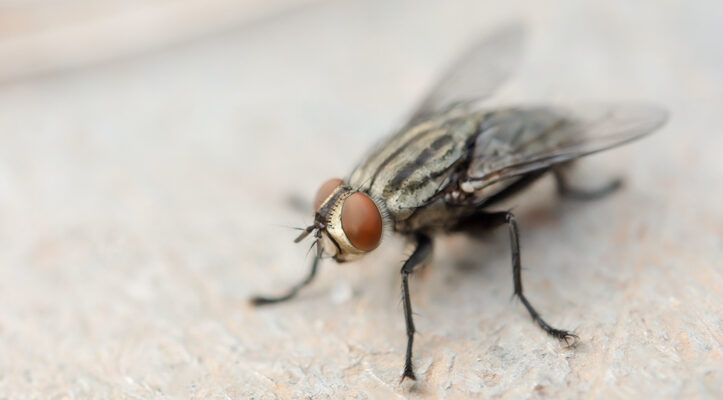
The house fly (Musca domestica) is one of the most common fly species on horse farms, dairies, poultry operations, and mixed animal properties across the United States. It’s a year-round presence in warmer climates and emerges with the first consistent warmth of spring in temperate regions.
House flies are more than a nuisance. They’re active vectors for disease — picking up pathogens from manure, animal waste, and decaying material and carrying them on their bodies, legs, and mouthparts to food, water, wounds, and animal feed.
For livestock producers specifically, the health implications of house flies are meaningful. Research published in the Journal of Medical Entomology found that house flies collected from cattle feedlots carried bacterial pathogens associated with bovine respiratory disease — one of the most economically significant illnesses in beef and dairy cattle. [2]
For horse owners, flies around wounds, eyes, and mucous membranes create direct irritation and disease transmission risk. For everyone on the farm, house fly populations that develop unchecked create conditions that are simply unpleasant — and unnecessarily hard to manage once populations peak in mid-summer.
💡 KEY INSIGHT: House flies aren’t just irritating — they’re documented mechanical vectors of over 130 pathogens identified in peer-reviewed research. Managing them effectively protects the health of your animals, your family, and your farm.
Effective fly control requires understanding how house flies develop — because the strategy that produces lasting results targets the life cycle where it’s most vulnerable, not just the adults you can see.
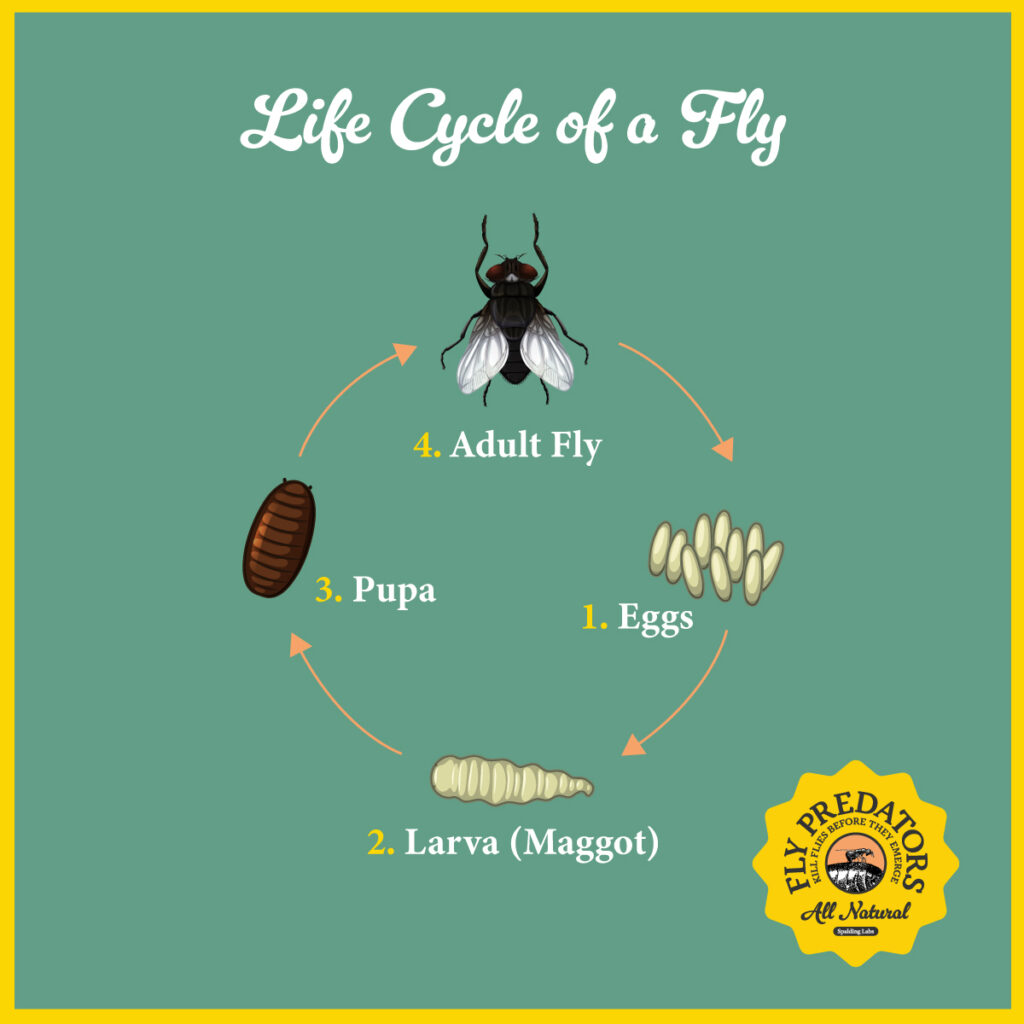
Egg Stage
Female house flies lay eggs in batches of approximately 150 on moist organic matter — manure, garbage, compost, and wet feed are the most common sites on farms. Eggs hatch within roughly 24 hours under warm conditions.
Larvae — commonly called maggots — are tiny, creamy-white, and feed actively on the decaying organic matter where eggs were laid. After feeding for several days, they migrate toward drier areas at the edges of breeding sites to pupate.
Pupae form a protective casing in drier areas near the breeding site, often just below the surface of soil or bedding. This is the stage where transformation to adult fly occurs — and the stage where Fly Predators do their most important work.
Adults emerge from pupae in approximately 8 to 14 days, with the fastest development occurring at higher temperatures. Female house flies live up to 3.5 weeks and lay four to six batches of eggs in that time.
💡 KEY INSIGHT: In warm spring and summer conditions, a house fly can complete its full life cycle — egg to reproducing adult — in as few as 8 days. One female lays hundreds of eggs across her lifetime. Fly populations that go unmanaged in spring are exponentially larger by summer.
Biological fly control uses naturally occurring beneficial insects — specifically parasitoid wasps — to interrupt the house fly life cycle at the pupal stage. This approach has been studied extensively and is a well-established component of integrated pest management programs on livestock and equine operations.
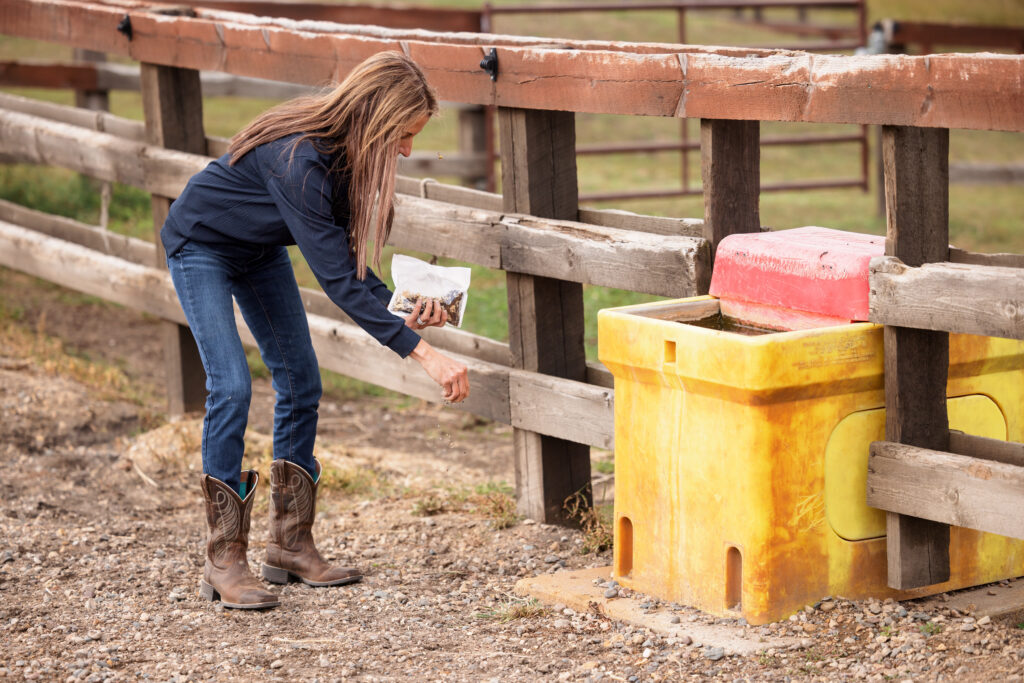
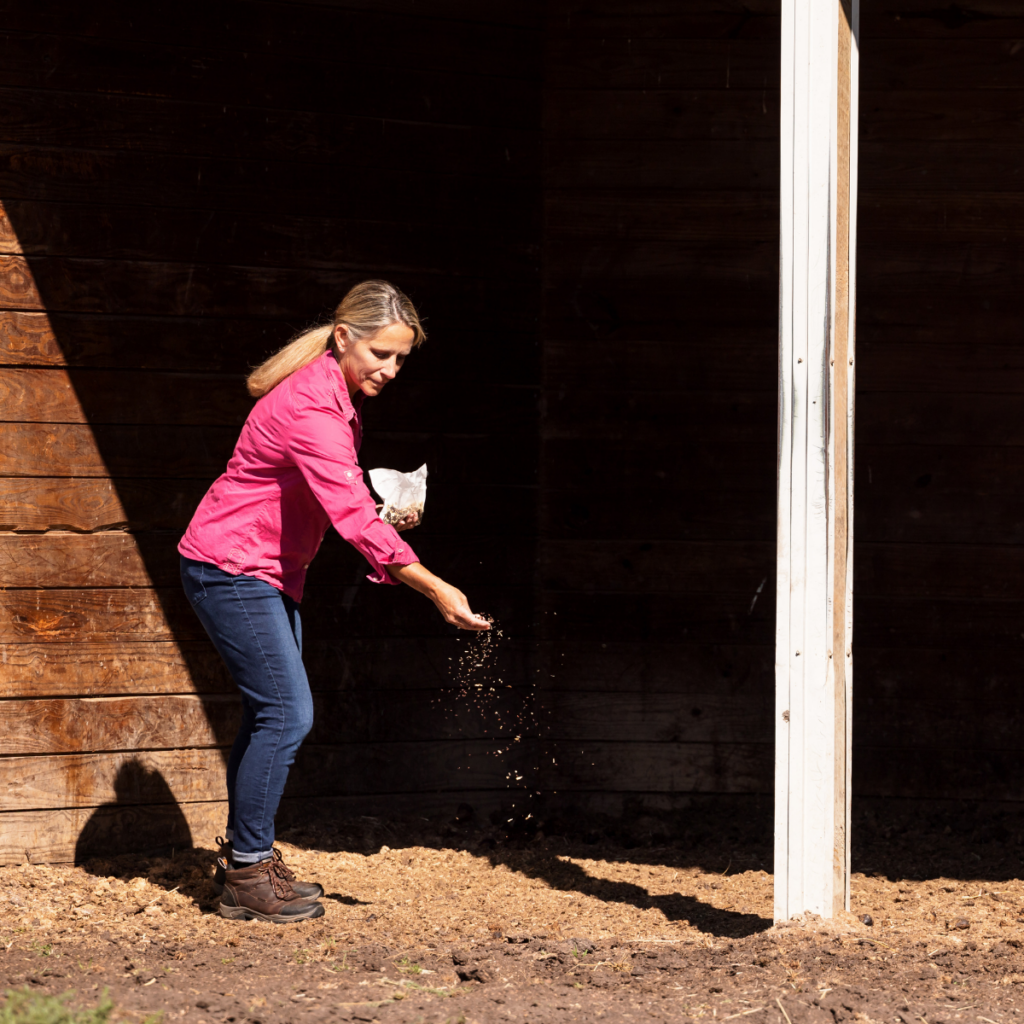

Fly Predators® are a carefully selected blend of parasitoid wasp species from the families Pteromalidae and Spalangiidae — naturally occurring insects that are native to farm environments. They find house fly pupae in manure, wet bedding, and other breeding material, and deposit their eggs inside the pupa. The developing parasitoid consumes the fly pupa before it can complete development into an adult fly.
The scientific evidence consistently supports a key practical point: parasitoid-based biological control works best when releases begin early in the season and continue consistently throughout fly season. Populations of beneficial insects build over time, establishing control before fly pressure peaks rather than catching up to an already-established population.
Fly Predators don’t replace every tool in your fly control program — they address the pupal stage of the fly life cycle that other products miss. Used consistently alongside good sanitation practices, they reduce the fly population and prevent it from building throughout the season.
💡 KEY INSIGHT: Biological fly control targets the stage of the house fly’s life cycle that sprays, traps, and repellents don’t reach. Fly Predators work beneath the surface — in the breeding sites themselves — before the next generation of flies ever emerges.
Fly Predators work by finding fly pupae in breeding sites — which means placement in the right locations is critical. Distributed randomly or in the wrong areas, they’ll find fewer pupae and provide less effective fly control. Distributed in the concentrated breeding zones on your property, they work with maximum efficiency. For most farms, Fly Predators should be distributed in these primary zones:
The highest-concentration breeding site on most farms. Distribute Fly Predators at the edges and surface of manure piles, compost windrows, and any area where manure accumulates. This is where the largest populations of fly pupae are often found.
Areas around feed bunks, round bale feeders, and hay storage where organic material mixes with moisture. Don’t overlook areas beneath and around grain feeders where spilled or rejected feed accumulates.
The ground around automatic waterers, troughs, and water lines develops persistent moisture and organic buildup. This is a frequently overlooked breeding site that can support significant fly development.
Areas where horses and cattle congregate and where manure accumulates. Particularly important in dry lots and smaller turnout areas where manure concentration is high relative to the area size.
Biological fly control produces its best results when used alongside consistent sanitation — not as a substitute for it. Research on integrated pest management programs consistently shows that combining biological and cultural controls produces better outcomes than either approach alone.
The reason is straightforward. Fly Predators target pupae already in breeding sites. Sanitation reduces the breeding sites themselves, which means fewer pupae for flies to produce and more concentrated breeding zones where Fly Predators can work most efficiently.
Remove manure from stalls and paddocks on a regular schedule rather than allowing it to accumulate. The more frequently manure is removed or turned, the fewer opportunities for fly larvae to complete development before Fly Predators intercept them at the pupal stage.
Keep feeding areas dry and clean. Wet, decomposing feed is a productive breeding site that’s easy to eliminate with prompt cleanup — and unlike manure, it’s entirely preventable.
Address drainage problems around water sources and high-traffic areas. Persistent wet spots create breeding conditions that Fly Predators may not fully compensate for if the habitat is large and consistently replenished.
For dairy operations, regular scraping and flushing of holding areas, alleys, and feed lanes removes the concentrated organic material that supports the largest fly populations on these properties.
💡 KEY INSIGHT: Biological control and cultural control are multipliers of each other. Good sanitation makes Fly Predators more effective by concentrating where they need to work. Fly Predators make sanitation more forgiving by intercepting the pupae that inevitably develop in any working farm environment.
Fly traps target adult flies — the ones already in flight and already reproducing. They don’t address the breeding cycle, but they reduce the adult population you’re dealing with day to day and can provide meaningful relief during peak pressure periods.
Used correctly, traps complement Fly Predators rather than competing with them. The key is placement — attractant traps should be placed outside buildings and at the perimeter of animal areas, drawing adult flies away from animals and barn interiors rather than concentrating them in areas where Fly Predators are active.
Avoid placing attractant traps inside stalls or directly adjacent to Fly Predator distribution zones. Fly traps attract and concentrate flies — which increases the risk of drawing additional flies into the area rather than reducing them where your animals spend time.
If you are uncertain about the right traps for your specific location and operation, a brief conversation with a fly control specialist can give you a personalized recommendation based on your region, your animals, and your property conditions.
Biological fly control is effective when implemented correctly — but there are a few common errors that reduce its impact significantly. Understanding them helps you get consistent results season after season.
Fly Predators are most effective when releases begin before fly populations have had a chance to build significantly. Starting in April, when the first house flies are appearing, is ideal for most of the country. Waiting until mid-summer means Fly Predators are working against an established, actively reproducing population rather than preventing one from building.
Consistent, regular releases throughout fly season are essential. Fly Predators complete their development and disperse — a single release doesn’t provide ongoing protection. Spalding Labs’ automated delivery schedule ensures releases happen at the right intervals for your specific location and property without requiring you to track timing manually.
Applying insecticide sprays directly to manure piles, stall bedding, or other Fly Predator distribution zones will kill beneficial insects alongside pest flies. If chemical control is needed for adult fly management, use targeted sprays on surfaces where adult flies rest — not in breeding areas. Fly baits placed away from Fly Predator zones are a better option for supplemental adult fly control.
Scattering Fly Predators randomly across a pasture or far from breeding sites means they’ll find few pupae and provide minimal fly control. Focus Fly Predator distribution on the concentrated breeding zones identified earlier in this post — manure areas, stall bedding edges, wet feed areas, and paddock hotspots.
Biological fly control works by reducing the next generation of flies before it hatches — which means results build over time rather than appearing overnight. Most customers notice a meaningful difference within four to six weeks of consistent use, with the most significant impact becoming clear as the season progresses and each successive generation is reduced. Patience and consistency are the keys.
💡 KEY INSIGHT: The farms that see the best results with biological fly control share one characteristic: consistency. Regular releases, started early, maintained throughout the season, and supported by good sanitation produce cumulative results that improve year over year.
The most effective time to begin active fly control measures is before daytime temperatures consistently reach 60°F in your region, which is when fly development accelerates significantly. For most animal owners this means completing spring cleanup in late winter and beginning biological control releases in early spring — often well before flies are visibly present. Spalding Labs’ custom delivery schedule accounts for your specific location and sends releases at the right intervals automatically.
The right quantity depends on the number and type of animals you have, your property size, your manure management practices, and your location. Spalding Labs uses a custom calculator that accounts for all of these factors to generate a personalized Fly Predator schedule. Call us or use the order tool on spalding-labs.com for a recommendation specific to your situation.
No. Fly Predators are completely harmless to horses, cattle, poultry, dogs, cats, humans, and beneficial insects including honeybees. They are species-specific parasitoids that target only fly pupae. Fly Predators don’t sting, don’t bite, and your animals will never notice them. They are native to North American farm environments and are not an introduced invasive species.
Fly Predators are effective against filth fly species that breed in manure and organic material, including house flies and biting stable flies. Their effectiveness varies somewhat by species and environmental conditions, which is why Spalding Labs uses a carefully selected blend of parasitoid species rather than a single type — optimizing performance across the range of pest flies common to farm environments.
Yes, though starting before fly populations peak produces better results. If flies are already present in significant numbers, we recommend combining Fly Predators with traps to address the existing adult population while biological control works on the next generation. Our team can recommend a catch-up approach for properties where fly pressure has already built — call 1-888-880-1579 for guidance specific to your situation.
Fly Predators are naturally adapted to farm environments and manure management conditions — they evolved in exactly these conditions. The parasitoid species selected by Spalding Labs are specifically chosen for their effectiveness in the environments typical of horse, cattle, and livestock operations, including the temperatures, humidity levels, and microbial conditions found in active manure and bedding areas.
You don’t need to stop using fly spray on animals — repellents applied to horses, cattle, and other animals do not affect Fly Predators, which are active in fly breeding areas rather than on or around animals. Avoid applying broad-spectrum insecticide sprays directly to manure piles, stall bedding, or other areas where Fly Predators are distributed, as this can reduce their populations. Targeted use of premise sprays on fly-resting surfaces (walls, rafters) away from breeding zones is compatible with biological fly control.
House fly season is underway across most of the country. The most effective biological fly control programs are already in place — releasing Fly Predators consistently, building beneficial insect populations before flies peak, and targeting the breeding cycle where it’s most vulnerable.
If you’re ready to build a program for your specific property, our entomologist-led team will build you a custom plan at no cost. We’ll account for your location, your animals, your acreage, and your current fly pressure to recommend the right quantities, the right timing, and the right placement strategy for your farm.
No obligation. Just practical guidance from people who have spent 50 years studying and solving fly problems on farms of every shape and size.

📞 Questions: 1-888-880-1579
📦 Ready to order: 1-888-562-5696
The earlier you start, the easier fly season gets. Don’t wait until you see flies this year – stay ahead of the swarm.