
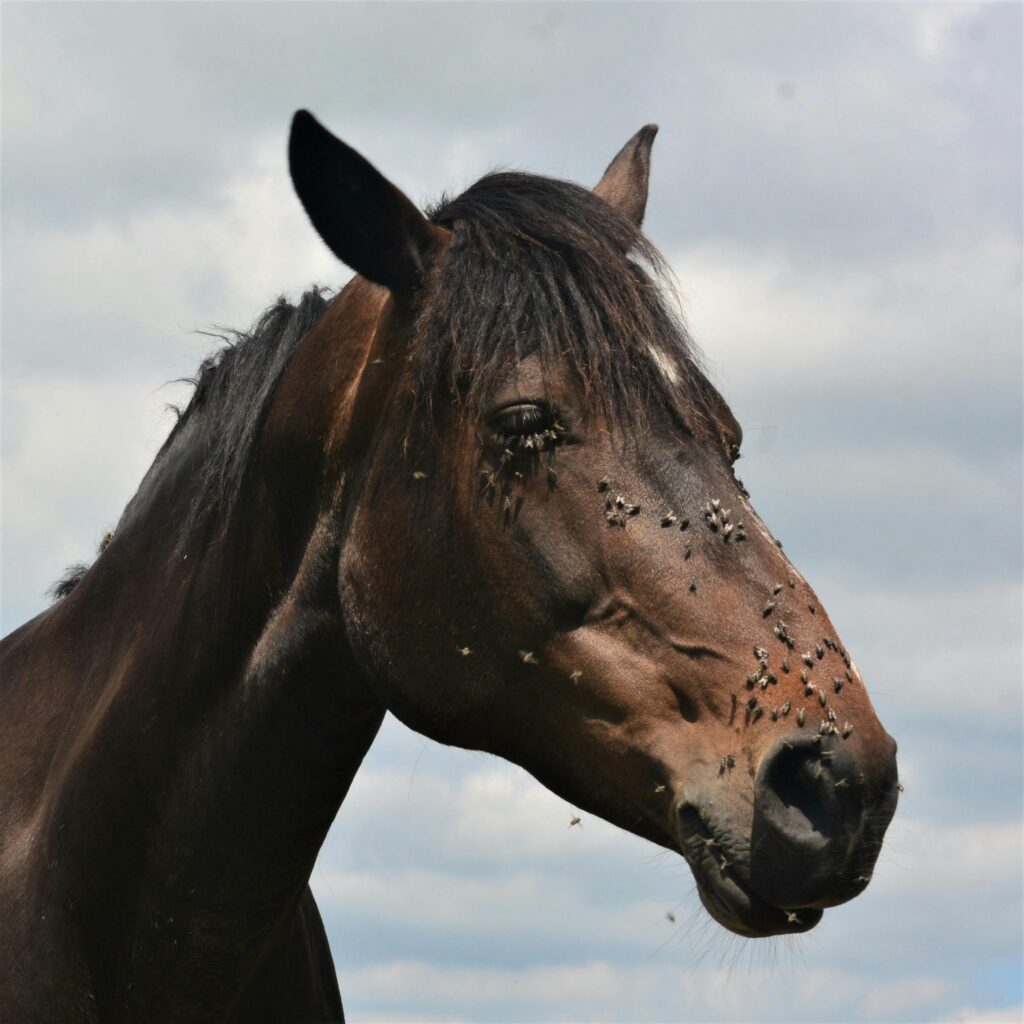
Something shifts on horse and livestock properties in mid-late spring. The flies that were an occasional nuisance have become a persistent presence. And if you’re watching your horses stomp their front legs, bunch in corners, or stand in any available water or shade — you’re seeing the signature of stable flies, the biting species that becomes a meaningful problem for farms across most of the country this time of year.
Mid-late spring is when both house flies and stable flies are actively hatching and building populations simultaneously — and when the biological control program you’ve established starts to prove its value. Understanding the difference between these two species, and what it means for your management approach, is the key to getting the best results from your fly control investments through the rest of the season.
This guide covers what’s happening on your property right now, how biological fly control works for each species, and the specific management practices that make the biggest difference in late spring and beyond.
In March and April, the primary fly pressure on most farms comes from house flies emerging from the manure and wet organic material that accumulated over winter. House fly populations build quickly — they can complete their life cycle in as few as 8 days in warm conditions — but they breed primarily in manure and wet organic material close to the barn, which means good cultural control and Fly Predator placement in those zones is highly effective against them.

Stable flies tell a different story. Their life cycle takes 21 to 25 days under ideal conditions, which means the first adults you’re seeing now emerged from eggs laid in early to mid-spring — hatching from the debris around winter hay feeding sites, decaying grass clippings, and wet silage or straw that’s been accumulating since fall. Unlike house flies, stable flies can travel significant distances from their breeding sites — research has documented stable flies moving miles on weather fronts to find a blood meal.
The result is that late spring often brings a fast-rising tide of stable flies that can appear to come from nowhere. And because they target the lower legs of horses and cattle rather than the face and eyes, their impact on animal behavior is immediate and visible.
💡 KEY INSIGHT: If your horses or cows are stomping their front feet and clustering near fans or in shaded, breezy spots, stable flies are the likely culprit — not house flies. Understanding which fly you’re dealing with determines how you manage it.
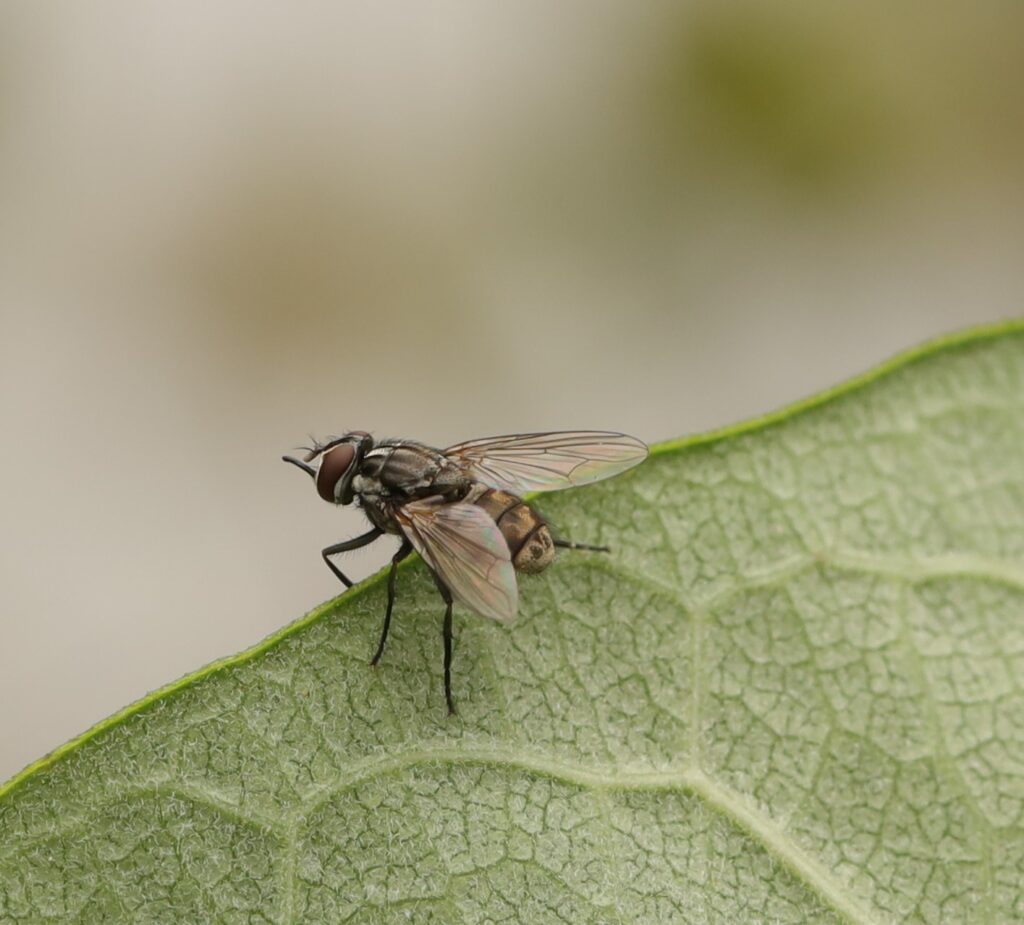
Stable flies and house flies look similar enough that many farm owners misidentify them — which leads to management decisions that target the wrong breeding sites. The key identification markers are the proboscis and the abdomen. Stable flies have a distinctive needle-like biting mouthpart that projects forward from the head, visible even in the field. Their abdomen also shows a checkerboard-like spotted pattern rather than the striped pattern of a house fly. Both sexes bite, which is unusual among pest flies. [8]
The management differences are equally important. Here’s how the two species compare across the characteristics that matter most for control:
| Characteristic | House Fly | Biting Stable Fly |
|---|---|---|
| Does it bite? | No — feeds on liquids, no blood | Yes — both sexes take blood meals |
| Primary breeding substrate | Manure, wet organic material | Decaying vegetation, wet hay, hay/manure mix |
| Round bale feeding sites? | Less significant | Major breeding source — up to 1M+ flies per site |
| Where it feeds on animals | Face, eyes, wounds (non-biting) | Lower legs (horses and cattle) |
| Economic threshold | No standard; nuisance-based | 5 flies per animal / 3 per leg in feedlots |
| Life cycle duration | 8–14 days (warm conditions) | 21–25 days; up to 78 days in cold |
| Dispersal range | Primarily stays near breeding site | Can travel miles on weather fronts |
| Fly Predator effectiveness | High — breeds primarily in manure | Moderate — most effective when breeding in manure-soiled straw/bedding |
The economic impact of stable flies on U.S. livestock production is well-documented and substantial. A comprehensive analysis published in the Journal of Medical Entomology estimated total annual losses from stable flies at more than $2.2 billion across dairy, cow-calf, stocker, and feeder cattle operations — making stable flies one of the most economically significant arthropod pests in American agriculture.
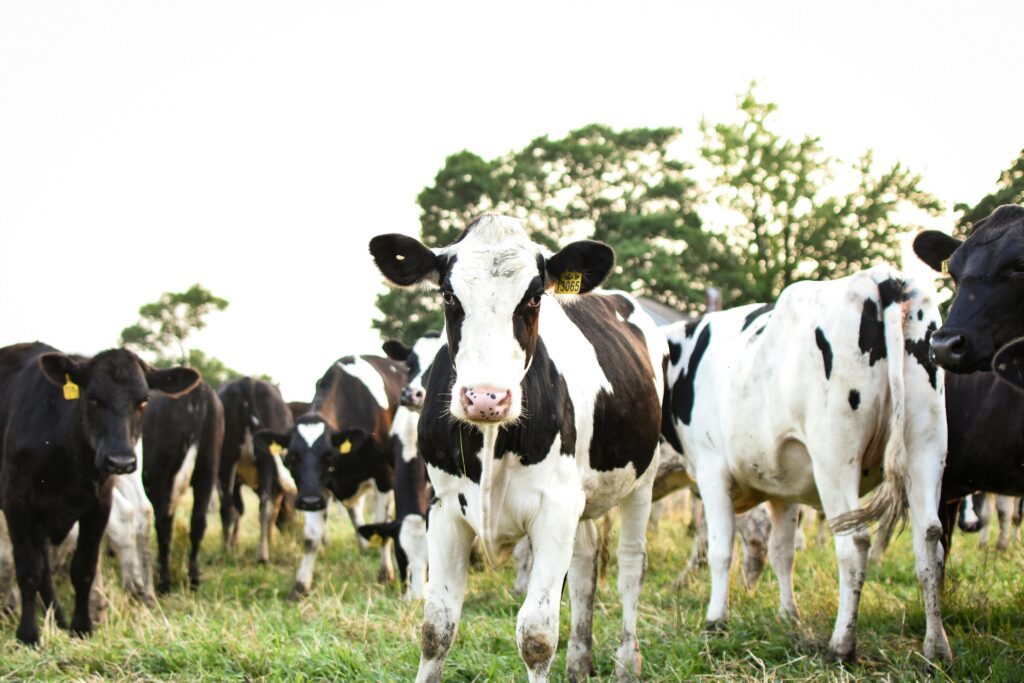
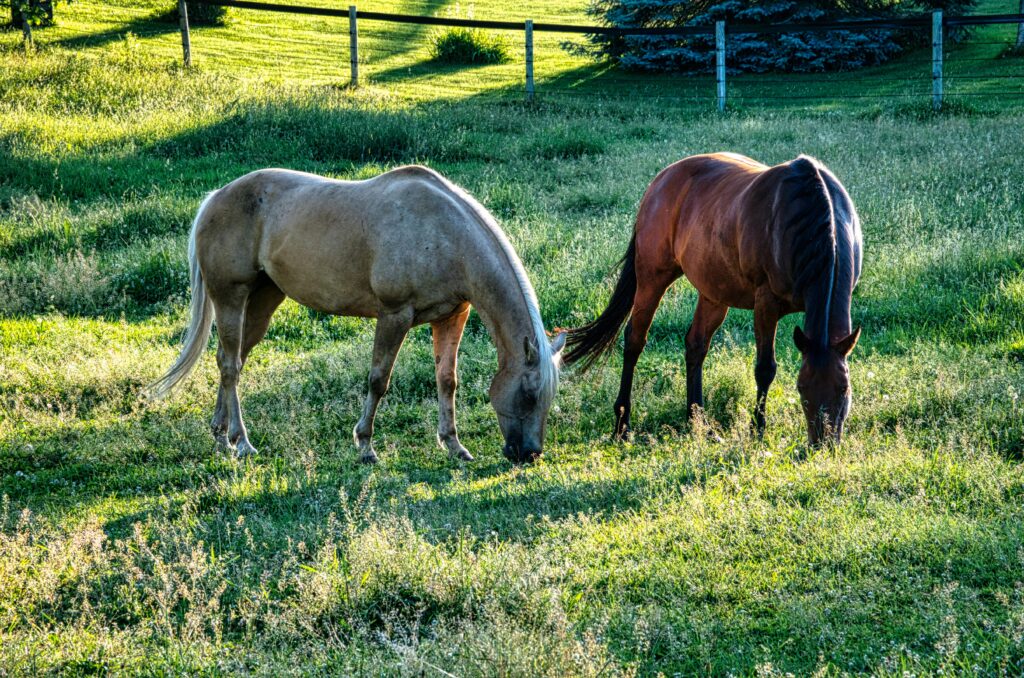
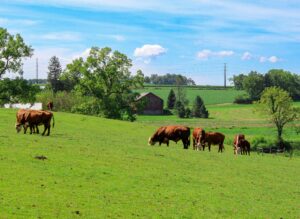
For horse owners, the economic case is less directly quantifiable than in dairy or beef operations, but the behavioral impact is significant and well-recognized. Horses under stable fly pressure spend energy and attention on fly avoidance — stomping, tail swishing, bunching, moving away from feeding areas — that disrupts training, increases stress, and reduces the overall quality of time spent at the barn. University of Florida research found that stable fly activity on equine facilities often involves flies that have traveled from cattle operations up to 1.5 km away, meaning the source of the pressure may not even be on the horse owner’s property.
The economic threshold most commonly cited in extension literature is 5 flies per animal for general livestock, and as few as 3 flies per leg for feedlot cattle. These are lower thresholds than many producers expect — stable fly pressure at or above these levels is associated with measurable production losses.
💡 KEY INSIGHT: A stable fly economic threshold of just 5 flies per animal — lower than most people expect — is associated with measurable production losses in cattle. For horse owners, the behavioral disruption begins at similarly low levels. This is a pest that warrants a proactive management strategy, not a reactive one.
Stable flies prefer to breed in decaying vegetation — particularly the wet, fermented mixture of hay, straw, silage, and manure that accumulates around winter feeding areas. Understanding this distinction is critical for both sanitation and biological control strategies.
Research from Texas A&M University has shown that a single average-sized winter hay feeding site can produce more than one million stable flies. The hay and manure mixture that accumulates around stationary round bale feeders, in straw bedding that’s been soiled over time, and at silage storage sites creates exactly the fermented, moist substrate that stable fly larvae require.
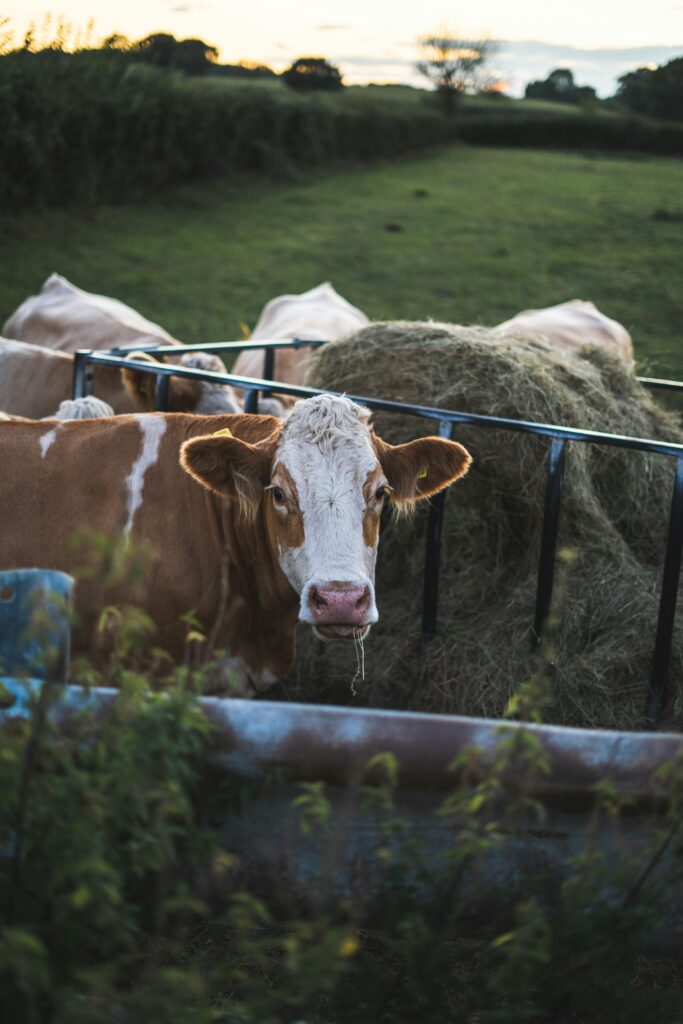
Other common stable fly breeding sites include:
What these sites share is fermented, moist plant material — not just manure. This matters for Fly Predator placement because the parasitoid wasps are most effective in areas they can physically access and where fly pupae are present in sufficient density.
Fly Predators are documented to parasitize stable fly pupae — confirmed in field studies including a 2024 IPM study that directly observed parasitoid wasps emerging from stable fly pupae in manure-soiled straw bedding. Used as part of a comprehensive integrated pest management program, they reduce the stable fly population that would otherwise continue building through the season.
The honest picture is that biological control of stable flies performs best as one component of a multi-tool strategy — not as a standalone intervention. House flies breed primarily in manure where Fly Predators are naturally concentrated and highly effective. Stable flies breed in substrates that are more variable and sometimes harder for parasitoids to access. This is why the guidance for stable fly management emphasizes habitat removal and adult trapping alongside Fly Predator releases, rather than Fly Predators alone.
What consistent Fly Predator use does contribute is cumulative pressure on the pupal stage across all fly breeding sites on the property — including the manure-soiled straw and bedding environments where stable flies develop alongside house flies. Each generation of flies that doesn’t hatch is a generation that isn’t laying eggs for the next cycle.
💡 KEY INSIGHT: Biological control is most effective against stable flies when it’s part of a program that also removes or disrupts the specific breeding habitats stable flies prefer. Fly Predators address what can be parasitized. Habitat management addresses what can’t be reached. Both are necessary for meaningful stable fly reduction.
With both house flies and stable flies building populations simultaneously, your placement strategy needs to address both species’ breeding zones. Distribution in the right locations is critical — scattered placement away from breeding sites produces little benefit. Concentrated placement in the areas where pupae are actually present produces meaningful results.
Maintain distribution near manure storage areas, animal bathroom areas, and the ground around water sources and feed areas. House fly pressure typically peaks in May and June for much of the United States and these zones remain the highest-priority placement locations through mid-summer.
Distribute Fly Predators in and around straw or hay-bedded areas where soiling and compaction have created stable fly development conditions. This includes stall bedding that contains significant hay or straw component, calf hutch bedding, and run-in shed or loafing area floors.
If hay waste or debris from winter feeding sites has not been fully removed or is actively decomposing, distribute Fly Predators at the edges of these areas. Stable fly pupae are present in the drier margins of these substrates, which is where parasitoid wasps can access them most effectively.
Silage or haylage storage areas with exposed or decomposing edges, straw piles, and grass clipping accumulations near the barn should also be included in distribution rounds. These productive stable fly breeding grounds are easy to overlook .
Fly Predator releases every 3 to 4 weeks throughout fly season is standard practice for most operations. In May and June — when both species are building simultaneously — maintaining that schedule consistently is particularly important. A skipped release during peak season means the next generation of flies develops with less parasitism pressure than the program was designed to deliver.
💡 KEY INSIGHT: Think of Fly Predator distribution as covering a map of your property’s known breeding zones — not just the areas closest to the barn. For stable fly control specifically, it’s the hay waste areas, straw bedding zones, and silage edges that need attention alongside the main manure areas.
If you used round bale feeders this past winter and the debris around those sites hasn’t been addressed, those areas are almost certainly producing significant stable fly populations right now. Texas A&M research data cited by extension literature indicates that over one million stable flies can emerge from the debris of a single average-sized winter hay feeding site. [8] This isn’t a background risk — it’s the primary source of early summer stable fly pressure on many horse and cattle properties.
The most effective intervention is physical removal or disruption of the substrate before fly pupae complete development. Here’s what that looks like in practice:
💡 KEY INSIGHT: The hay debris around round bale feeding sites is one of the single most productive stable fly breeding sources on many horse and cattle properties. Addressing these areas in early spring — before fly pupae complete development — is the highest-return sanitation action you can take for stable fly control.
Stable fly trapping is meaningfully different from house fly trapping, and the distinction matters for where and how you place them. House flies are attracted to odor-based traps that replicate the smell of decomposing organic material — their food source. Stable flies are not attracted to these traps. Instead, they respond to visual cues and carbon dioxide from their hosts.
Stable fly traps work on visual attraction — typically flat panel or sphere-type traps in blue or black, colors that stable flies are drawn to. They should be placed between the animals and the area where flies are coming from, or near the lower leg height where stable flies prefer to feed. Alsynite fiberglass traps are the most studied design in research literature, and should be placed in areas with strong afternoon sunlight to attract stable flies.
Important placement notes: stable fly traps should be positioned in sunny, open areas where adult flies are active — not inside stalls or dark barn interiors. Placement near animals or at the perimeter of loafing areas and holding pens, where flies aggregate to access hosts, tends to yield the best capture rates.
If you started Fly Predators in early spring, the program is now entering its most important phase — the period when consistent releases allow beneficial insect populations to build alongside increasing fly pressure rather than always reacting to it. Here are the practices that distinguish operations that see the best results through the summer.
Skipping a release during May or June is the most common reason programs underperform. The interval between releases is calibrated to ensure new Fly Predators are establishing before previous populations disperse. A gap during peak fly season gives fly pupae a window to complete development without parasitism — and that generation becomes the breeders for the next cycle.
If fly pressure is higher than expected, or if weather conditions — a wet spring, cool delays followed by rapid warmth — have resulted in compressed hatching, contact Spalding Labs to discuss whether a supplemental release is warranted. The custom schedule is a strong baseline, but exceptional conditions sometimes benefit from adjustment.
Mid-spring is a good time to walk your property and reassess where fly breeding is most concentrated. If you’re seeing higher pressure in a specific area — a particular paddock, a feed storage zone, a run-in shed — that’s a signal that the breeding source in that area deserves more attention, whether through sanitation or targeted Fly Predator distribution.
As the season gets busy, sanitation is the first practice to slip. Biological fly control and good sanitation multiply each other — Fly Predators work most efficiently when they don’t have to cover an overwhelming volume of fly breeding material. Maintaining regular manure management and hay waste cleanup through May and June keeps your fly control program performing at its highest level.
💡 KEY INSIGHT: Consistency through May and June — the two months when both house fly and stable fly populations are building most rapidly across much of the country — determines how manageable the rest of the fly season will be. The farms that stay on schedule now have easier summers.
The clearest visual identifier is the proboscis — stable flies have a stiff, needle-like mouthpart that projects forward from the head. House flies do not bite. On horses, stable fly pressure typically causes stomping of the front legs and you may notice animals clustering in shaded, breezy areas. House fly pressure causes head-tossing, tail swishing, and flies congregating near the eyes, nose, and wounds. Both types of fly can be present simultaneously in late spring, which is why observing where flies are landing on your animals is useful.
Yes — Fly Predators are documented to parasitize stable fly pupae, with emergence from stable fly pupae confirmed in field studies. They are most effective when stable flies are breeding in areas where Fly Predators can reach the pupae — particularly in manure-soiled straw and bedding areas. Stable flies that breed in large open hay waste sites or dry, compacted debris may be harder to reach with parasitoids. This is why stable fly management is most effective when Fly Predators are combined with physical removal or disruption of the primary fly breeding habitats. Our entomologist can recommend a placement strategy specific to your property.
No. Fly Predators are completely harmless to horses, cattle, poultry, dogs, cats, humans, and beneficial insects including honeybees. They are species-specific parasitoids that target only fly pupae. Fly Predators don’t sting, don’t bite, and your animals will never notice them. They are native to North American farm environments and are not an introduced invasive species.
Agricultural literature commonly cites 5 stable flies per animal as the threshold at which treatment is economically justified for livestock producers — and as few as 3 flies per leg for feedlot cattle. For horse owners, the threshold is behavioral: if horses are consistently stomping their front feet, clustering to avoid flies, or avoiding feeding areas because of fly pressure, treatment is warranted regardless of exact fly counts.
Stable fly traps are most useful in late spring through fall, when adult populations are at their highest. They work best as a complement to biological control and habitat management — reducing the adult population while Fly Predators work on the developing generation. Position visual-attraction traps between your animals and the likely fly approach direction, at approximately leg height, in sunny open areas.
It’s not too late — starting Fly Predators in late spring is significantly more effective than waiting longer or not starting at all. A later start is most effective with a supplemental Fly Predator release to help build beneficial insect populations faster, along with intensified sanitation to reduce the fly breeding that has already occurred. Call us at 1-888-880-1579 and our team can recommend a fly control approach for your specific situation.
You don’t need to stop using fly spray on animals — repellents applied to horses, cattle, and other animals do not affect Fly Predators, which are active in fly breeding areas rather than on or around animals. Avoid applying broad-spectrum insecticide sprays directly to manure piles, stall bedding, or other areas where Fly Predators are distributed, as this can reduce their populations. Targeted use of premise sprays on fly-resting surfaces (walls, rafters) away from breeding zones is compatible with biological fly control.
Starting your fly control now can mean the difference between a comfortable farm or a fly infestation. The biggest difference between the two is usually a combination of consistent biological control releases, targeted habitat management for stable fly breeding sites, and using the right traps for each fly species.
If you have questions about what you’re seeing on your property — whether that’s an unexpected spike in flies, uncertainty about where they’re breeding, or a Fly Predator program you’d like to optimize — our entomologist-led team is here to help. There’s no charge and no obligation. Just a conversation with people who have spent 50 years working specifically on this problem.

📞 Questions: 1-888-880-1579
📦 Ready to order: 1-888-562-5696
The earlier you start, the easier fly season gets. Don’t wait until you see flies this year – stay ahead of the swarm.